
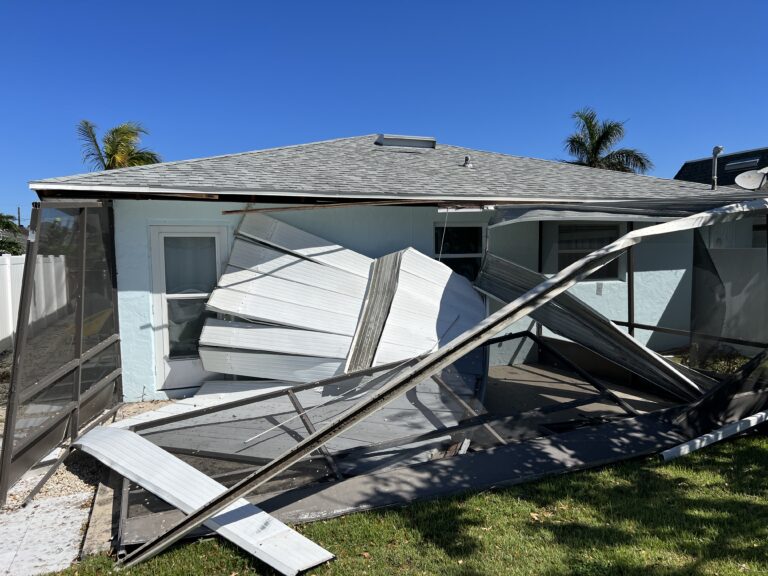
Roof Insurance Claims Southwest Florida — Licensed Contractor & Adjuster
Roofer LLC provides roof insurance claim support throughout Southwest Florida — helping homeowners in Naples, Bonita Springs, Estero, Marco Island, Lehigh Acres, and Fort Myers navigate the full claims process from initial damage inspection through final settlement and complete restoration. Our owner David Samadnejad holds both Florida roofing contractor license CCC1330693 and a Florida insurance adjuster license (G078220). That dual licensing is the foundation of everything we do in the claims space: it means the same professional who assesses your roof damage also understands the insurance process that determines how much of that damage gets paid — and is legally and professionally obligated to represent your interests, not the carrier's.
Most roofing contractors who offer to "help with your claim" are doing so informally, without any adjuster licensing and without the legal standing to represent you in a dispute with your insurer. When a claim gets complicated — when a carrier denies coverage, disputes your scope, invokes a pre-existing condition argument, or comes in with a settlement that falls short of what restoration actually costs — a contractor without adjuster credentials has no professional standing to push back on your behalf. We do.
What Roof Damage Your Homeowner's Policy Actually Covers — A standard Florida homeowner's policy covers sudden and accidental physical loss to your roof from a defined set of causes. Wind is the most common in Southwest Florida: everyday thunderstorms, tropical systems that don't reach named-storm status, squall lines, and the routine severe weather that Florida produces throughout the year. Hail is covered, though less frequent in the Naples corridor than in other parts of Florida. Falling objects — a tree branch, a palm frond driven by wind, a neighbor's unsecured patio furniture — are covered when they impact and damage your roof. Fire damage, lightning strikes, and the weight of ice or snow (rare but not unheard of) are also standard covered perils under most policies.
What your standard homeowner's policy does not cover is equally important to understand: normal wear and deterioration, maintenance failures, and pre-existing conditions are excluded. This is the opening carriers use most aggressively in Southwest Florida — characterizing storm damage on an older roof as pre-existing wear rather than event-caused loss, which shifts the homeowner's claim from the covered column to the excluded column. Navigating that distinction correctly requires both the roofing expertise to identify what the storm actually caused and the adjuster knowledge to document it in the format and with the specificity that withstands carrier challenge.
The Named Storm Distinction — Wind Claims vs. Hurricane Claims — Florida homeowner's policies draw a critical distinction between hurricane or named storm events and all other wind events. When a named tropical storm or hurricane causes your roof damage, your named storm deductible applies — a percentage of your home's insured value, typically 2% to 5%, rather than a flat dollar deductible. For a home insured at $400,000, that means $8,000 to $20,000 comes out of pocket before coverage begins. For all other wind events — non-named thunderstorms, squall lines, cold fronts with high winds, tropical disturbances that never received a name — your standard flat deductible applies, which is almost always significantly lower. Understanding which deductible structure applies to your specific loss is one of the first and most important determinations in any roof damage claim, and it is part of every initial assessment we conduct.
How the Claims Process Works — and Where It Goes Wrong — A roof damage insurance claim begins with the damage inspection and documentation. This is the most important moment in the entire process: what gets documented at the first inspection, how it is documented, and what language is used to describe cause of loss will determine the trajectory of the entire claim. Carriers send their own adjusters to inspect damage, and those adjusters work for the carrier — their professional interest is in accurate assessment, but their employer's financial interest is in minimizing settlement. When no independent professional is present during the carrier adjuster's inspection, the homeowner has no means to challenge an initial scope that misses items, mischaracterizes damage, or assigns an inadequate replacement value.
Common problems that emerge from unrepresented roof damage claims include: scopes that identify surface damage without accounting for underlying deck or structural damage, depreciation applied at rates that effectively reduce the settlement to less than actual repair cost, code-required upgrade costs excluded from scope even though current Florida Building Code requires them, and material pricing that doesn't reflect actual current market costs. Each of these problems can be addressed — through supplement filing, the appraisal process, or carrier dispute procedures — but addressing them is far more straightforward when the independent documentation was established at the first inspection than when you're trying to reopen or challenge a settled claim after the fact.
Wind Damage Claims in Southwest Florida — Wind is the dominant cause of roof insurance claims across the Naples corridor, and it presents in several distinct patterns depending on roof type, storm intensity, and installation quality. Shingle roofs experience tab liftings, seal strip failures, and full shingle displacements during high-wind events. Tile roofs — the predominant type in Southwest Florida — develop ridge and hip cap losses, field tile displacements, and underlayment exposure when wind gets under the leading edge of improperly seated tiles. Metal roofs experience fastener pull-through, panel separations at seams, and flashing failures. Flat and low-slope roofs are susceptible to membrane liftings and edge failures that create water intrusion pathways even when the visible surface appears intact.
All of these damage patterns share a common problem: they are not fully visible from the ground. A homeowner looking at a roof after a wind event may see obvious damage — missing tiles, exposed decking — or may see nothing obvious at all. A trained inspector on the roof surface will identify damage that a drive-by or ground-level carrier inspection will miss, and that missed damage is exactly what produces the supplement claims and dispute processes that follow underpaid initial settlements.
Hail and Falling Object Claims — Hail claims in Southwest Florida are less common than wind claims but follow the same documentation requirements: the damage must be distinguished from pre-existing wear, the cause of loss must be documented with specificity, and the scope must account for all affected components rather than just visible surface damage. Hail impact on tile roofing often produces damage that is only visible on close inspection of the tile surface and underlayment, and carrier adjusters conducting rapid inspections in high-volume claim environments routinely miss it. Falling object claims — trees, branches, and debris driven by wind — typically produce clear physical evidence but require scope documentation that captures structural and deck damage beneath the visible surface damage.
Insurance Claim Support for Southwest Florida Homeowners — We provide complete roof insurance claim support from initial inspection through final settlement: damage documentation formatted to the insurance adjuster standard, claim filing support, independent professional presence during the carrier's adjuster inspection, supplement filing for incomplete initial scopes, cause-of-loss documentation that withstands pre-existing condition challenges, and appraisal process support when disputes arise. Once the claim is correctly resolved, we complete the full restoration — to current Florida Building Code standards, with materials and installation quality that the settlement should have covered from the start.
We serve homeowners across Southwest Florida for all types of covered roof damage claims:
Roof Insurance Claims Naples
Roof Insurance Claims Bonita Springs
Roof Insurance Claims Estero
Roof Insurance Claims Marco Island
Roof Insurance Claims Lehigh Acres
Roof Insurance Claims Fort Myers
Call Roofer LLC at (239) 398-2316 for roof insurance claim support anywhere in Southwest Florida. We serve Naples, Bonita Springs, Estero, Marco Island, Lehigh Acres, and Fort Myers.