
TPO Roofing Contractor Southwest Florida — Roofer LLC
Roofer LLC installs, repairs, and replaces TPO roofing systems on commercial properties throughout Southwest Florida — serving property owners and managers in Naples, Bonita Springs, Estero, Marco Island, Lehigh Acres, and Fort Myers. Our owner David Samadnejad has held Florida roofing contractor license CCC1330693 since 2012 and holds GAF Commercial Certification with specialized training on GAF EverGuard TPO systems, GAF Rhino Bond induction welding, and fully adhered glue-down TPO installations. GAF Commercial Certification means we can install EverGuard TPO systems to the specification that qualifies for GAF's manufacturer-backed warranty programs — including NDL (No Dollar Limit) coverage for qualifying installations. We install TPO to manufacturer specification, pull permits through the appropriate county building department, and complete every installation to the Florida Building Code wind resistance requirements that Southwest Florida's storm environment demands.
TPO — thermoplastic polyolefin — is currently the most widely installed commercial flat roofing membrane in the United States, and for good reason. It is the right material for a wide range of commercial flat roofing applications in Southwest Florida's climate. Understanding why requires understanding what TPO actually is, how it performs in this specific environment, and what separates a correctly installed TPO system from one that will generate service calls within its first few years.
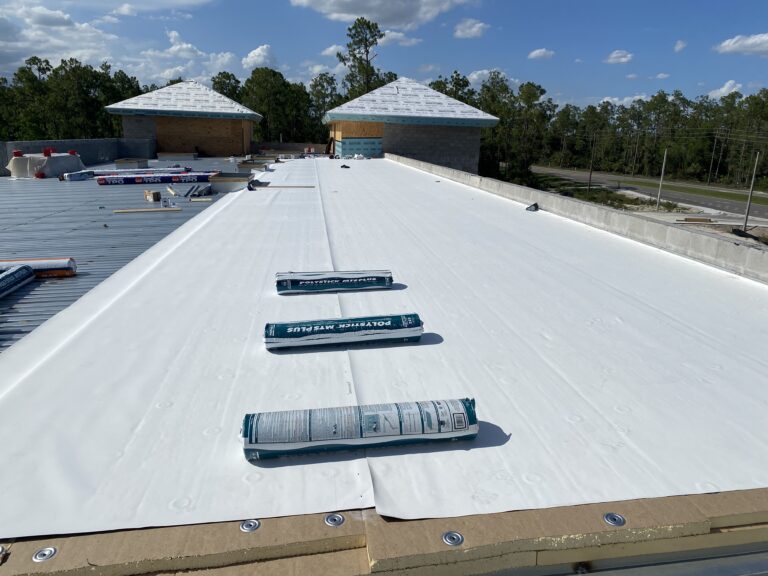
What TPO Is — and Why It Dominates the Commercial Flat Roofing Market — TPO is a single-ply roofing membrane composed of a thermoplastic polyolefin polymer reinforced with a polyester scrim or fiberglass mat. It is manufactured in rolls and installed across the roof deck in overlapping sheets that are joined at every seam with a heat welder — a handheld or robotic tool that fuses the overlapping membrane edges together with hot air, creating a continuous waterproof bond at every seam that, when correctly executed, is as strong as or stronger than the membrane itself.
The combination of properties that makes TPO the dominant commercial membrane is well-matched to Southwest Florida's climate and code requirements. The standard white or light-colored TPO surface reflects a significant portion of the solar energy that strikes it — reducing the roof surface temperature and, by extension, the building's cooling load in a market where HVAC costs are a year-round operational expense rather than a seasonal one. The thermoplastic composition allows the membrane to be heat-welded rather than adhesively bonded, which produces seam integrity that adhesive systems cannot consistently achieve. And the polymer formulation resists UV degradation, ponding water, and the biological growth that Southwest Florida's humidity promotes on roofing surfaces more effectively than many competing membrane types.
Membrane Thickness — 45 Mil, 60 Mil, and 80 Mil — TPO membranes are manufactured in standard thicknesses of 45 mil, 60 mil, and 80 mil (thousandths of an inch). The thickness of the membrane affects its puncture resistance, its longevity under traffic and foot load, its performance under UV exposure over time, and critically, the specifications required by most manufacturer warranty programs. In Southwest Florida's commercial roofing market, the correct thickness specification depends on the application, the building's use, and the warranty requirement the property owner needs to satisfy.
45 mil TPO is the entry-level commercial specification — adequate for low-traffic applications and short-term performance requirements but not the specification that manufacturer warranty programs require for extended coverage on most commercial buildings. 60 mil is the current standard specification for most Southwest Florida commercial applications: it qualifies for manufacturer warranty programs at standard coverage levels, provides meaningfully better puncture resistance than 45 mil under normal rooftop traffic, and has a well-documented performance history in Florida's climate. 80 mil is the specification for applications that demand maximum performance — high-traffic rooftops, buildings where the warranty term is a financing or insurance requirement, and commercial properties where the cost of a premature system failure is substantially higher than the incremental cost of upgrading to the heavier membrane. We discuss thickness specification with every commercial property owner as part of the initial project scoping — because selling a 45 mil system to a building that needs 60 mil is a cost savings that shows up as a service problem within a few years.
Installation Methods — Mechanically Attached and Fully Adhered — TPO systems are installed using one of two primary attachment methods, each with different performance characteristics and appropriate applications.
Mechanically attached TPO is fastened to the roof deck using fasteners driven through the membrane at the seam edges, which are then overlapped and heat-welded by the next sheet. The fasteners bear the wind uplift load, transferring it to the deck structure. Mechanically attached systems are faster to install, less sensitive to temperature and surface conditions during installation, and appropriate for the majority of commercial flat roofing applications in Southwest Florida when the deck structure and fastener pull-out values are adequate for the wind uplift loads the building's design requires.
Fully adhered TPO is bonded to the substrate across the entire membrane surface using a bonding adhesive, with seams heat-welded in the same manner as mechanically attached systems. Fully adhered installation provides superior wind uplift resistance in high-exposure applications — waterfront commercial buildings, rooftop parapet heights that generate increased uplift, and buildings in Lee County and Collier County's highest wind exposure zones where the mechanically attached specification does not achieve the required uplift resistance. The tradeoff is installation complexity: fully adhered systems require clean, dry substrates and specific temperature conditions during adhesive application, and a fully adhered installation done incorrectly is harder to identify and more consequential than a mechanically attached installation with the same deficiency.
A third installation method that we are specifically trained and certified to install is GAF Rhino Bond — an induction welding system proprietary to GAF EverGuard. Rather than fastening through the membrane at seam edges or bonding with liquid adhesive, Rhino Bond uses special metal plates bonded to the insulation layer beneath the membrane. An induction welding tool activates these plates electromagnetically through the membrane surface, fusing the membrane to each plate without penetrating it. The result is an attachment system with exceptional wind uplift resistance — no fastener points that create stress concentrations in the membrane, no adhesive application that is sensitive to temperature and humidity during installation — and a membrane surface that is completely uninterrupted by mechanical fasteners. Rhino Bond is the correct specification for high-wind-exposure applications, buildings that require the highest available uplift resistance rating, and commercial properties where the EverGuard warranty program's Rhino Bond requirements apply. We also install fully adhered glue-down TPO for applications where the substrate and project conditions favor that method.
We specify the installation method for every TPO project based on the building's wind exposure requirements, the deck structure, and the manufacturer warranty specification — not on which method is faster to install.
Heat Welding — Why Seam Quality Is the Most Important Factor in Any TPO Installation — Every TPO roofing system, regardless of membrane thickness or installation method, ultimately performs as well as its seams. A TPO membrane with flawless field installation but improperly welded seams will fail at those seams — admitting water at the exact locations where two sheets overlap, which are the lowest points in the roof plane and the first locations where standing water concentrates. Seam failures are the most common cause of TPO system failure in commercial buildings throughout Southwest Florida, and they are almost entirely the product of installation quality — not material deficiency.
Correct seam welding requires the right equipment (a calibrated hot-air welder, not a hand-held gun used inconsistently), the right temperature and speed settings for the ambient conditions, clean and dry membrane surfaces at the weld zone, and consistent technique from the installer executing the weld. A seam weld that looks acceptable on the surface and passes a cursory visual inspection can still be inadequate — under-welded seams that have surface fusion but insufficient depth of bond will delaminate under thermal cycling and wind uplift stress within a few years of installation.
We probe every seam on every TPO installation we complete — a physical inspection process that tests the bond quality across the full seam length, not just at visible endpoints. Seams that do not pass probe inspection are rewelded before the project is closed out. This is standard practice in a correctly executed TPO installation; it is not standard practice in the broader commercial roofing market, which is why TPO seam failures are as common as they are.
TPO vs. EPDM vs. Modified Bitumen — Which Is Right for Your Building? — Property owners comparing flat roofing systems often ask how TPO compares to the two most common alternatives. The honest answer is that each system has applications where it is the correct choice, and the selection should be driven by the building's specific requirements rather than by a contractor's preference for a particular material.
EPDM (rubber membrane) is the more flexible of the two single-ply systems — it conforms to irregular geometry and complex rooflines more easily than TPO and is appropriate for buildings with high penetration density or unusual shapes where TPO detailing would be complex. EPDM is typically black, which means it absorbs rather than reflects solar energy — a meaningful cooling load consideration in Southwest Florida's year-round heat that makes TPO the better specification for most applications where aesthetics and energy performance both matter. EPDM seams are adhesively bonded rather than heat-welded, which requires more rigorous substrate preparation and introduces a different category of seam failure risk. Modified bitumen is an asphalt-based system with a performance and application profile distinct from either single-ply option. It is appropriate for high-traffic applications, rooftops with complex flashing requirements, and buildings where the installation environment makes a single-ply system difficult to execute correctly.
Modified bitumen systems do not have the reflectivity of white TPO, and their service life in Southwest Florida's UV environment is shorter than a correctly installed TPO system of equivalent thickness. For the majority of Southwest Florida commercial flat roofing applications — standard building geometry, adequate deck structure, rooftop traffic within normal maintenance parameters — TPO is the correct specification. We are clear when it is not the right choice and will recommend the alternative that is.
Manufacturer Warranty — What It Covers and What It Requires — Most commercial property lenders, insurers, and institutional owners require a manufacturer-backed warranty on roofing systems, and the warranty specification drives many of the installation decisions on a TPO project — membrane thickness, installation method, flashing details, and the contractor's certification status with the manufacturer. We are GAF Commercial Certified and install GAF EverGuard TPO systems to the specification required for GAF's manufacturer warranty programs — including GAF's NDL (No Dollar Limit) warranty coverage for qualifying installations, which removes the per-occurrence cap on covered repairs and is the warranty standard that commercial lenders and institutional property owners frequently require. Our GAF certification covers EverGuard TPO in mechanically attached, Rhino Bond induction welded, and fully adhered glue-down configurations. We also install TPO systems from other major commercial membrane manufacturers including Firestone, Carlisle, and Johns Manville for projects where those systems are specified or preferred.
A manufacturer warranty on a TPO system is not a blanket guarantee against any roofing failure — it covers defects in the membrane material itself, and it contains specific requirements about installation method, membrane thickness, flashing details, and in some cases the identity of the installing contractor. Understanding what a manufacturer warranty covers — and more importantly what it does not cover — is part of what we explain to every commercial property owner before a TPO project scope is finalized. A warranty that requires 60 mil membrane and a certified installer to be valid is not satisfied by a 45 mil installation by an uncertified contractor, regardless of what language appears on the warranty document.
TPO Roofing Insurance Claims — When a Southwest Florida commercial property sustains storm damage to a TPO roofing system, the insurance claim process presents the same challenges as any commercial roofing claim — a carrier whose financial interest is in minimizing the settlement, an initial scope that frequently misses items or mischaracterizes damage, and a depreciation calculation that may not reflect the actual condition of the system before the storm event. David Samadnejad holds a Florida insurance adjuster license (G078220) in addition to his roofing contractor license, which means we can support the full TPO damage claim from initial documentation through final settlement — and then complete the installation or restoration once the claim is correctly resolved.
We provide TPO roofing services throughout Southwest Florida:
Call Roofer LLC at (239) 398-2316 for TPO roofing anywhere in Southwest Florida. Free estimates on all TPO installation, repair, and replacement projects.